SLScloud is equipped with a full grown BIBFRAME Editor. It provides a user-friendly cataloging interface for the creation of bibliographic linked data.
Read this brochure (PDF) and watch this video (5 min) for an overview of the Editor. Also, watch this video (5 min) to learn how to create catalog records in BIBFRAME at ease. For an introduction of linked data, read this presentation (PDF).
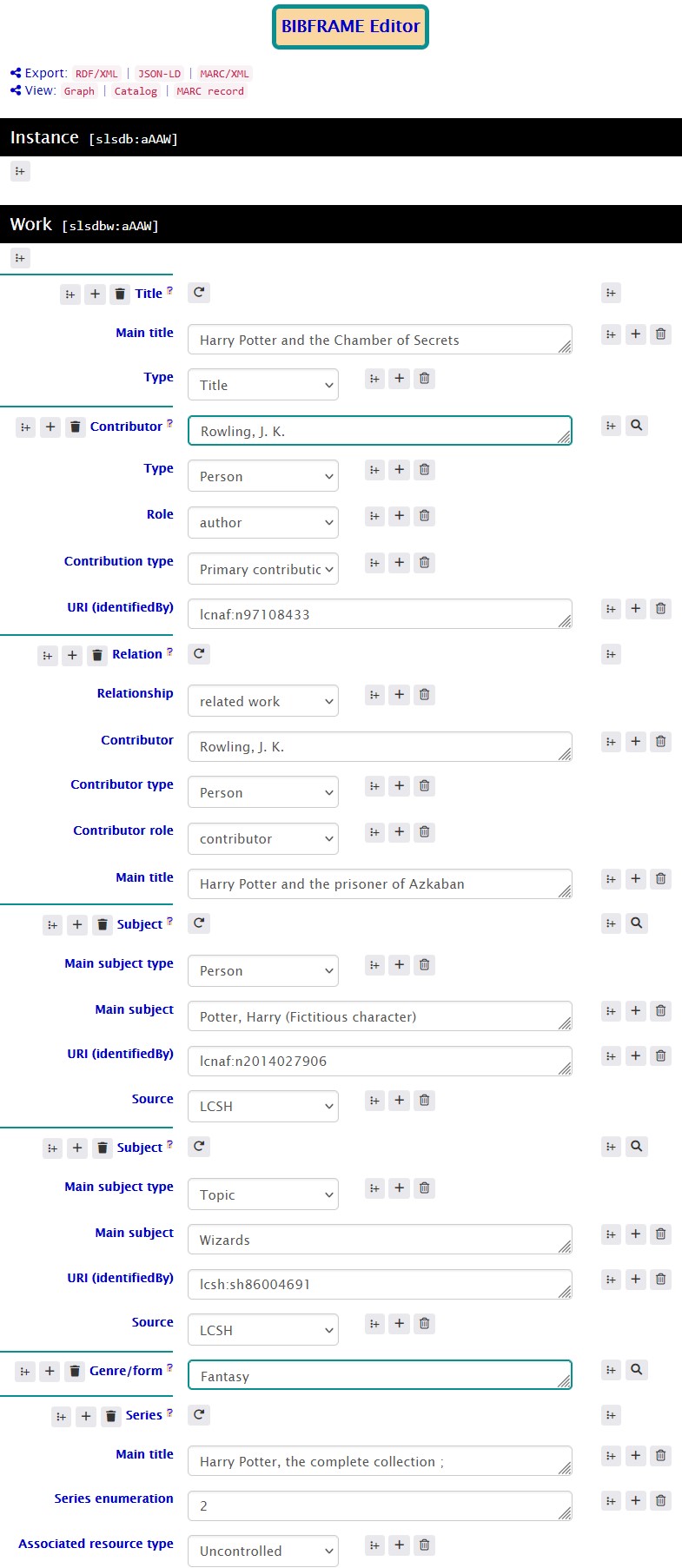
BIBFRAME linked data is stored in the build-in triplestore and is available for SPARQL querying.
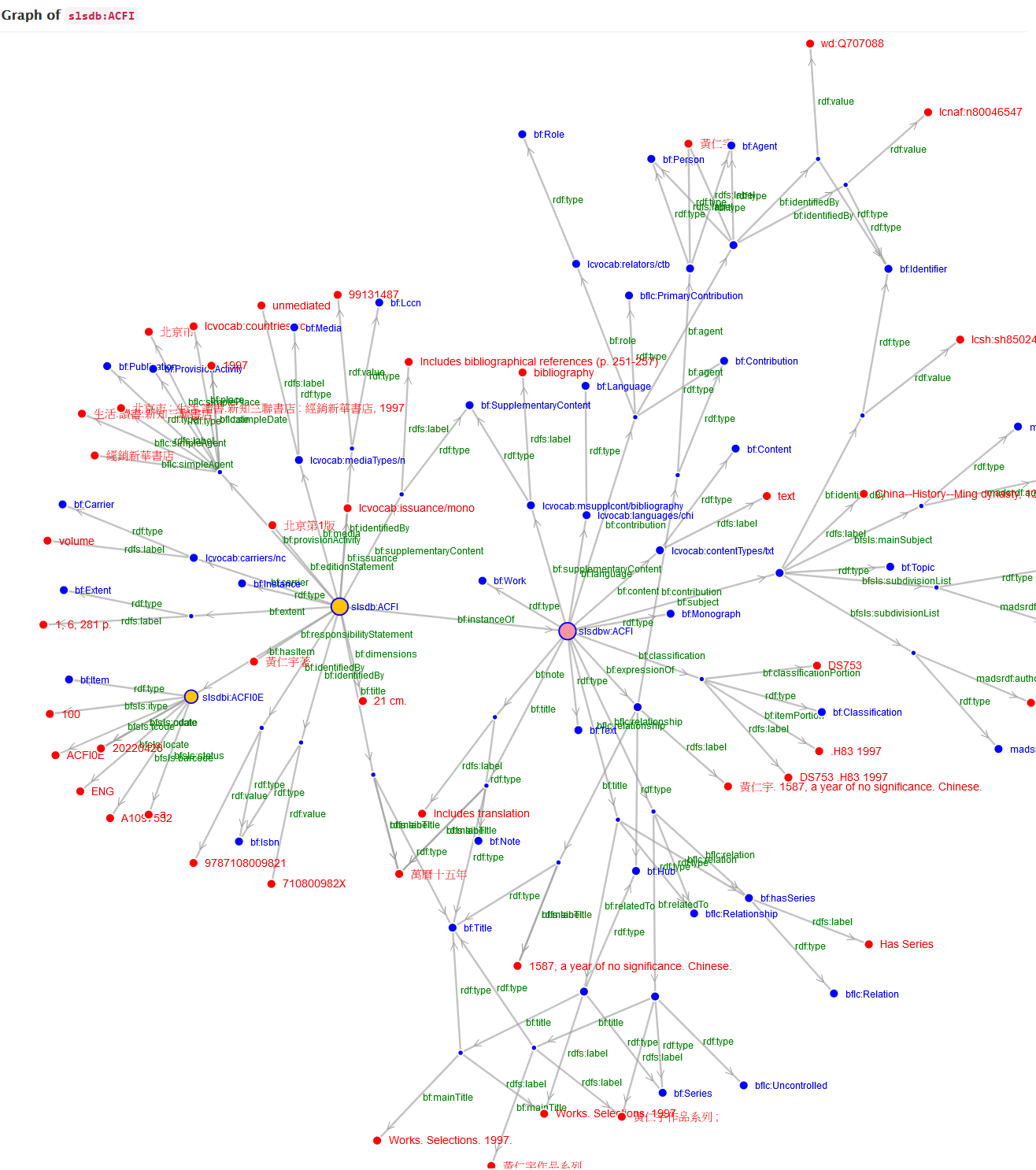
Through the use of AI agent technology, a MCP (Model Context Protocol) client, acting as an AI agent, was set up to chat with a LLM (Large Language Model). It facilitated the model to search the triplestore of a SLSCloud library catalog and do all sort of labor works. The preliminary results were quite promising.
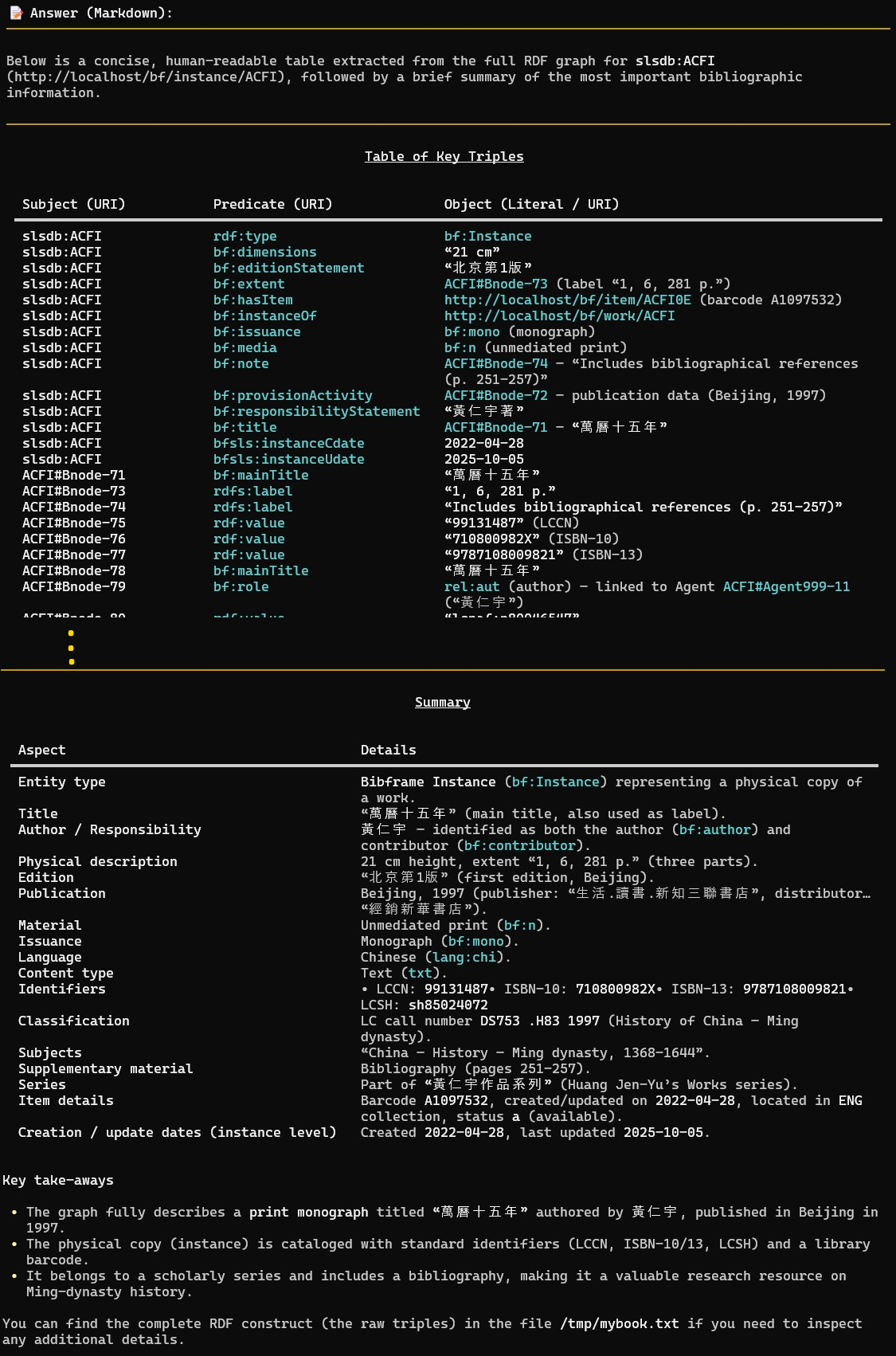
For example, when asking the agent to "generate a sparql query to retrieve graph slsdb:ACFI, where slsdb: is the prefix <http://localhost/bf/instance/>. execute the sparql query on the dataset slsdb and retrieve the graph. format the graph in table format and summarize the information in the table. save to file /tmp/mybook.txt", the agent accurately (no hallucination, hooray!) generated a response with details of the bibliographic information:
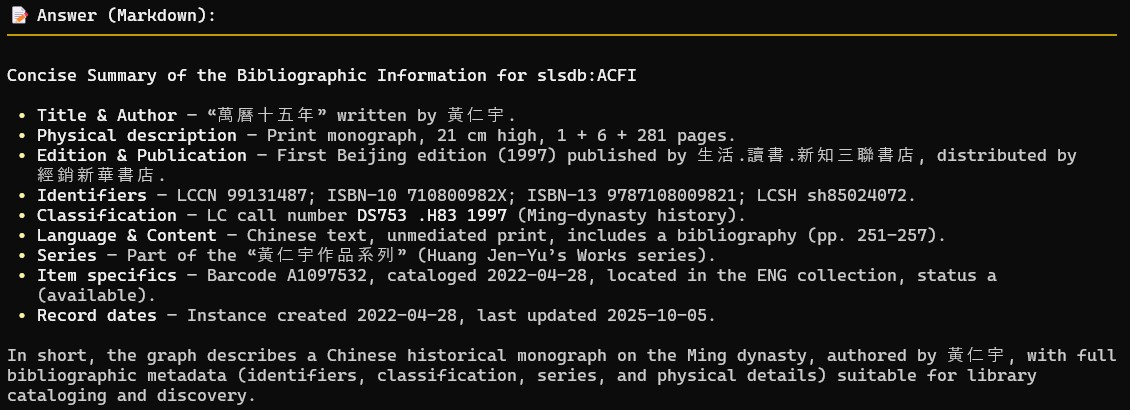
Further asking the agent to "summarize the summary table", the agent returned a concise summary based on the bibliographic information it retrieved previously:
Note that slsdb:ACFI is the URI of the BIBFRAME instance for a record in the library catalog. I then asked the agent to convert the RDF bibliographic metadata to MARCXML format, and it did. The conversion was done by the model itself and the result was okay. It could be much better if there was a MCP tool specially created for this conversion purpose.
This brief exploration demonstrated the feassibilty of creating AI agents to assist librarians in their daily works and to improve library users' information discovery.
--K.T. Lam, last revised: 18 January 2026
The SLS library management system has been in use since 1991. It is designed specifically for small-sized libraries, including school, church, and special libraries.
View an historical image of the DOS version of OPAC released in 1992. Refer to the following presentations and video about the early history of SLS:
SLSCloud Platform
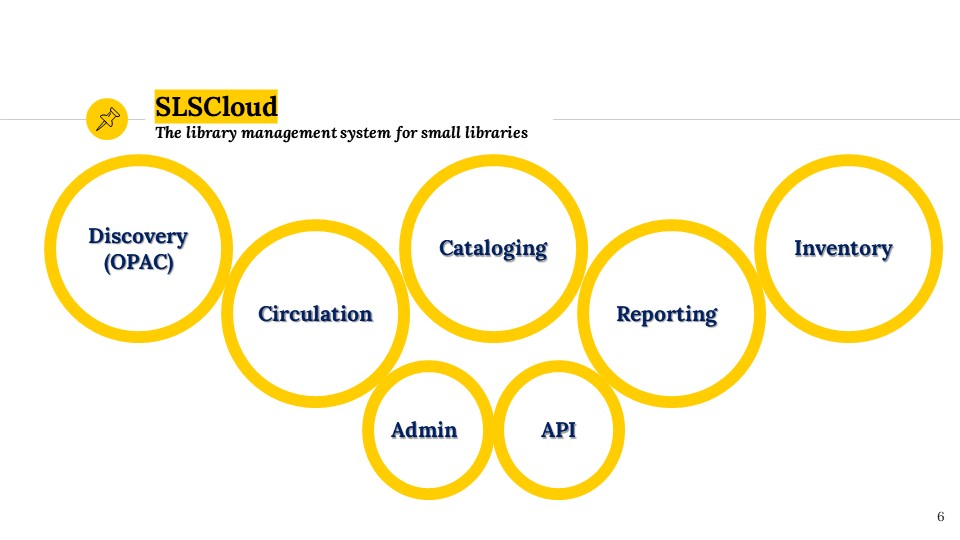
SLSCloud Platform offers SLSCloud OPAC and a full set of library management services including catalog management, circulation, patron management, report management and system management.
Download SLSCloud Platform information brochure.
Subscription
SLSCloud Platform is currently provided through TR Computer Limited. They can be reached by calling (852) 2772-1619 or sending email to helpdesk@tr-computer.com.hk.
This is to announce the release of Read2Learn (悅讀智庫), a SLSCloud Platform module that enables libraries to set up reading community through their library catalogs.
It is especially useful for school libraries to conduct reading promotion campaign for their students, by encouraging them to read books and reflect their thoughts in writing as book reviews. Peer students can interact by posting comments on these reviews. Read2Learn implements a scoring system. By earning scores through reading and writing reviews or comments, they are given incentive to check out library books and engage in reading.
Screen shots of Read2Learn:
[ Browse book reviews |
My readings |
My reviews |
My comments |
Admin - mark and approve submissions ]
SLSCloud Platform is now in general release. It offers SLSCloud OPAC and a full set of library management services including Catalog Management, Circulation, Patron Management, Report Management, and System Management.
The Windows-based SLS software modules (i.e., those Win* and Web* programs, such as WinCIRC and WebCAT) have been discontinued. Existing SLS users who are still using Win*/Web* are encouraged to migrate to the SLSCloud Platform as soon as possible to enjoy the benefit of this linked-data based library service platform.
SLSCloud's Circulation module is now in general release. It leverages linked data technology for library staff to perform daily circulation activities, patron management, usage reporting and circuation notice generation.
Existing SLS WinCIRC users are encouraged to migrate to the SLSCloud platform to enjoy the benefit of this newly added next-generation library system management tools.
SLS BIBFRAME Editor is now in general release. It is a part of the SLSCloud library mangement system, providing SLS users with cutting edge cataloging experience.
The Editor can also be deployed as a learning platform in standalone mode. Libraries can use the platform to learn original and copy cataloging in BIBFRAME and understand how bibliographic metadata is represented and queried in linked data. Using this platform, you will have a first-hand opportunity to practice creation of BIBFRAME linked data, importing MARC to the system and exporting it back to MARC. You can also explore its Linked Data Query Service and learn how BIBFRAME data are interlinked with external linked data sources such as Wikidata.
See this brochure for an overview of the SLS BIBFRAME Editor. Libraries interested in subscribing it can contact our service provider mentioned in the brochure.
Several enhancements and updates are added to this December 2019 release, together with the software refreshed to support the latest version of WordPress.
